


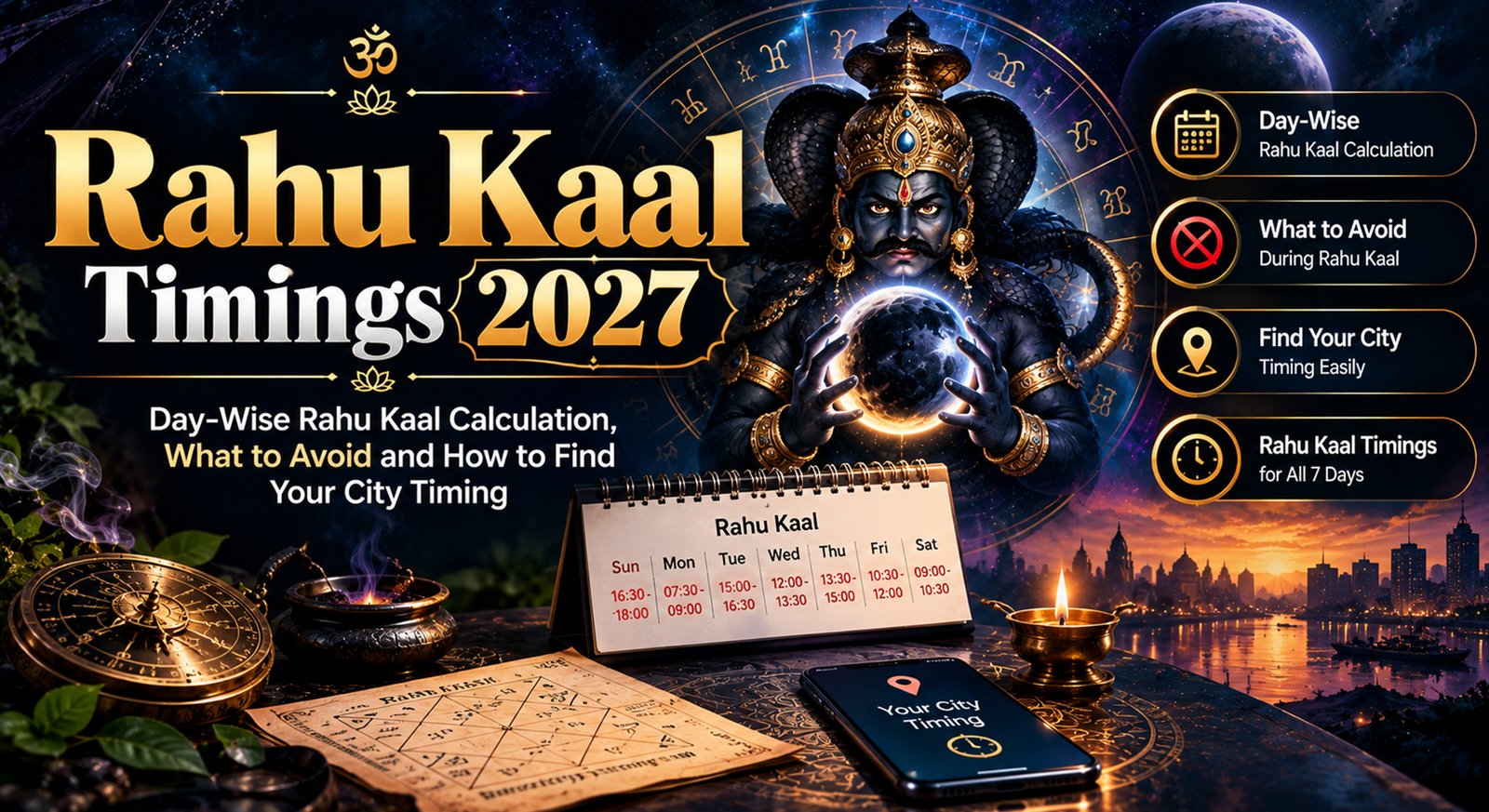
Rahu Kaal Timings 2027: Day-Wise Rahu Kaal Calculation, What to Avoid and How to Find Your City Timing
If you are planning important work in 2027, knowing rahu kaal 2027 helps you avoid starting it in an inauspicious window of the day. For most people, the confusion starts with one question: “My calendar shows one time, my friend’s app shows another. Which do I trust?”
This guide clears that confusion. You will see how Rahu Kaal is actually calculated, how it changes by weekday and city, what to avoid in that period, and how to quickly check accurate timings for your location in India.
What Is Rahu Kaal And Why Does It Matter?
Rahu Kaal (or rahukalam) is a daily time period ruled by Rahu when starting new ventures is generally avoided in Hindu astrology. It does not depend on your horoscope but on the sunrise time of that day at your location.
Astrologers treat this window as sensitive for fresh beginnings. Common practice in many Indian families is to avoid starting travel, signing documents, major purchases, or first-time rituals during this slot, while routine or ongoing work can continue.
Standard Day-Wise Rahu Kaal Pattern For 2027
The pattern of Rahu Kaal across weekdays stays the same every year. Only the actual clock timings shift according to local sunrise. That is why a ready weekday pattern or rahu kaal chart is so handy.
Here is the standard order of Rahu Kaal during the day, counted from sunrise, which applies across years including 2027:
- Monday: 2nd period after sunrise
- Tuesday: 7th period after sunrise
- Wednesday: 5th period after sunrise
- Thursday: 6th period after sunrise
- Friday: 4th period after sunrise
- Saturday: 3rd period after sunrise
- Sunday: 8th period after sunrise
Each “period” is one-eighth of the time between sunrise and sunset for that day in your city. Once you know this, you can work out the exact window for any date in 2027 instead of relying on a generic table.
How To Calculate Day-Wise Rahu Kaal Timings
You can calculate Day-wise timings by hand if you know your local sunrise and sunset times. This is the basic method most Panchang apps use behind the scenes.
8-Step Method To Calculate Daily Rahu Kaal
Follow this simple approach to calculate Day-wise timings for your city on any chosen date:
- Note the sunrise time for that date and city.
- Note the sunset time for the same date and city.
- Calculate the total duration between sunrise and sunset in minutes.
- Divide that duration by 8 to get one segment length.
- Check which weekday it is and find the Rahu Kaal segment number from the pattern above.
- Multiply the segment length by (segment number – 1) and add to sunrise to get the start time.
- Add one segment length to that start time to get the end time.
- Round to the nearest minute for practical use.
This is why two cities will almost always show slightly different timings, even on the same date. The difference comes from distinct sunrise and sunset times, not from a different rule.
Example: How City Location Changes Rahu Kaal
Imagine Monday in January with sunrise around 7:00 am and sunset close to 6:00 pm in a north Indian city. The day length is shorter, each segment is smaller, and so the Rahu Kaal window will be shifted compared to a coastal city with a slightly longer day.
This is also why printed calendars that use one fixed city as reference often do not match what you see in a local Panchang app, even though both follow the same calculation rule.
What You Should Avoid During Rahu Kaal
Astrology texts and household practice focus on what you start, not what you continue. The general guideline is that fresh, significant beginnings should wait until after this period ends.
People commonly avoid these activities during Rahu Kaal:
- Starting long-distance travel or first-time journeys to a new place
- Initiating important business deals, negotiations, or partnerships
- Signing contracts, loan documents, or property papers
- Beginning construction work, house shifting, or office opening ceremonies
- Starting first-time job joining rituals or interviews, if you have control over timing
Routine tasks carried over from before, like office work, studying, cooking, or commuting, are generally considered fine. The concern is mainly about the first decisive step of something meaningful.
Simple Remedies If Work Cannot Avoid Rahu Kaal
Life does not always bend to an auspicious window. Exams, office meetings, hospital visits, or government appointments often fall exactly when you would like them not to. When avoiding the period is impossible, many people follow small remedies for mental peace.
Common Rahu Kaal Remedies Followed At Home
Here are some widely followed, simple practices people use when important work must begin in this period:
- Starting the day with a short prayer to your family deity before Rahu Kaal even begins
- Chanting a Rahu-related mantra quietly on your own if you have already been advised one
- Offering black sesame seeds or mustard oil in worship, as guided by a personal astrologer
- Donating food or basic items to those in need as a general remedy for planetary imbalance
These are traditional faith-based practices. They are followed for spiritual comfort and should never replace practical planning or professional advice in matters like health, law, or finance.
How To Find Accurate Rahu Kaal For Your City
The biggest source of confusion is seeing different timings in different places: one on a wall calendar, another on your phone, and a third on a television channel. To sort this out, focus on the source of sunrise and sunset data.
Here are practical ways to get accurate Day timings for your exact location:
- Use a Panchang app that lets you set your city or latitude-longitude, not just your state.
- When using printed almanacs, check which reference city they follow and how close it is to you.
- For border towns or remote areas, synchronise with the nearest major city that shares similar sunrise times.
- If you move between cities often, save the main cities you travel to in your app and switch location before checking.
If you see minor differences of a few minutes between sources, pick one accurate, location-based method and stick to it consistently instead of jumping between several tables.
Why “Rahu Kaal Today” Differs From “Rahu Kaal Tomorrow”
You might notice that the window for rahu kaal today does not match the slot shown for the next day. That is expected because the sunrise and sunset gap changes slightly every day, especially around seasonal shifts.
The same logic applies when you check aaj ka rahu kaal against a previous date or festival day. Even if both fall on a Monday, the day length will not be identical, so the calculated slot moves forward or backward by a few minutes.
Planning Your 2027 With Rahu Kaal In Mind
By 2027, many people will be using Panchang features on their phone as routinely as a weather forecast. Treating Rahu Kaal like another planning parameter makes it easier to respect tradition without getting stuck.
Here is a simple way to use these timings through the year:
- Check rahu kaal timings first while fixing dates for weddings, housewarmings, or business openings.
- When planning major travel, see rahu kaal tomorrow the night before and adjust departure by a small margin if possible.
- For daily office work, use reminders based on your rahu kaal today window to avoid scheduling new project kick-offs exactly in that slot.
- Keep a printed or saved rahu kaal chart for quick reference to segment numbers, then use an app only for the exact minutes.
This balanced approach respects astrological timing while staying practical about modern schedules and commitments.
How 2027 Rahu Kaal Differs Across Indian Cities
Because India spans a wide east–west distance, city-based differences are normal. Eastern cities experience earlier sunrise compared to western cities, so their calculated segments will also be earlier by the clock.
Someone checking rahu kaal 2027 from Guwahati will naturally see a different slot than a person in Ahmedabad on the same date. Both are correct for their location as long as the calculation follows the sunrise-based 8-part rule.
Conclusion
Understanding rahu kaal 2027 is mainly about one thing: learning the 8-part daytime division and the weekday pattern so you can trust your own calculation or a reliable Panchang app. Once you know that, conflicting tables stop being confusing.
Use those timings to avoid starting significant work in that slot when you reasonably can, lean on simple remedies when you cannot, and consult an astrologer from Bhavishya Astro if you need guidance tailored to your horoscope and city.
Frequently Asked Questions
Q1. Can I do puja during Rahu Kaal in 2027?
Ans. Daily prayers and ongoing worship are generally considered acceptable during Rahu Kaal. The caution is mainly about beginning new rituals, major life events, or first-time spiritual vows in this period.
Q2. Is online work or office job joining affected by Rahu Kaal?
Ans. Many people avoid scheduling the formal joining moment, signing HR papers, or first client calls in Rahu Kaal if they have control over timing. Regular office tasks, remote work, and continuing projects are usually treated as fine.
Q3. Does Rahu Kaal apply at night or only in the daytime?
Ans. Rahu Kaal is calculated only within the daytime between local sunrise and sunset, divided into eight segments. There is no separate Rahu Kaal period during the night; other time rules may apply but are calculated differently.
Q4. Why does my app show different Rahu Kaal from my wall calendar?
Ans. Apps often calculate timings using your phone’s location and local sunrise, while wall calendars usually follow one reference city. Even small differences in sunrise between cities can shift the window, so both can be correct for their own basis.
Q5. Can travelling during Rahu Kaal cause problems?
Ans. Tradition suggests avoiding the start of important journeys in Rahu Kaal. Many people simply delay the first movement of the trip by a short time, while continuing a journey that began before the period or after it is generally accepted.
Q6. Is Rahu Kaal different from Yamagandam and Gulika Kaal?
Ans. Yes, these are three separate inauspicious periods calculated from sunrise using different rules and segment numbers. Many Panchang apps display all three together, but Rahu Kaal is usually given the most practical importance for new beginnings.


