


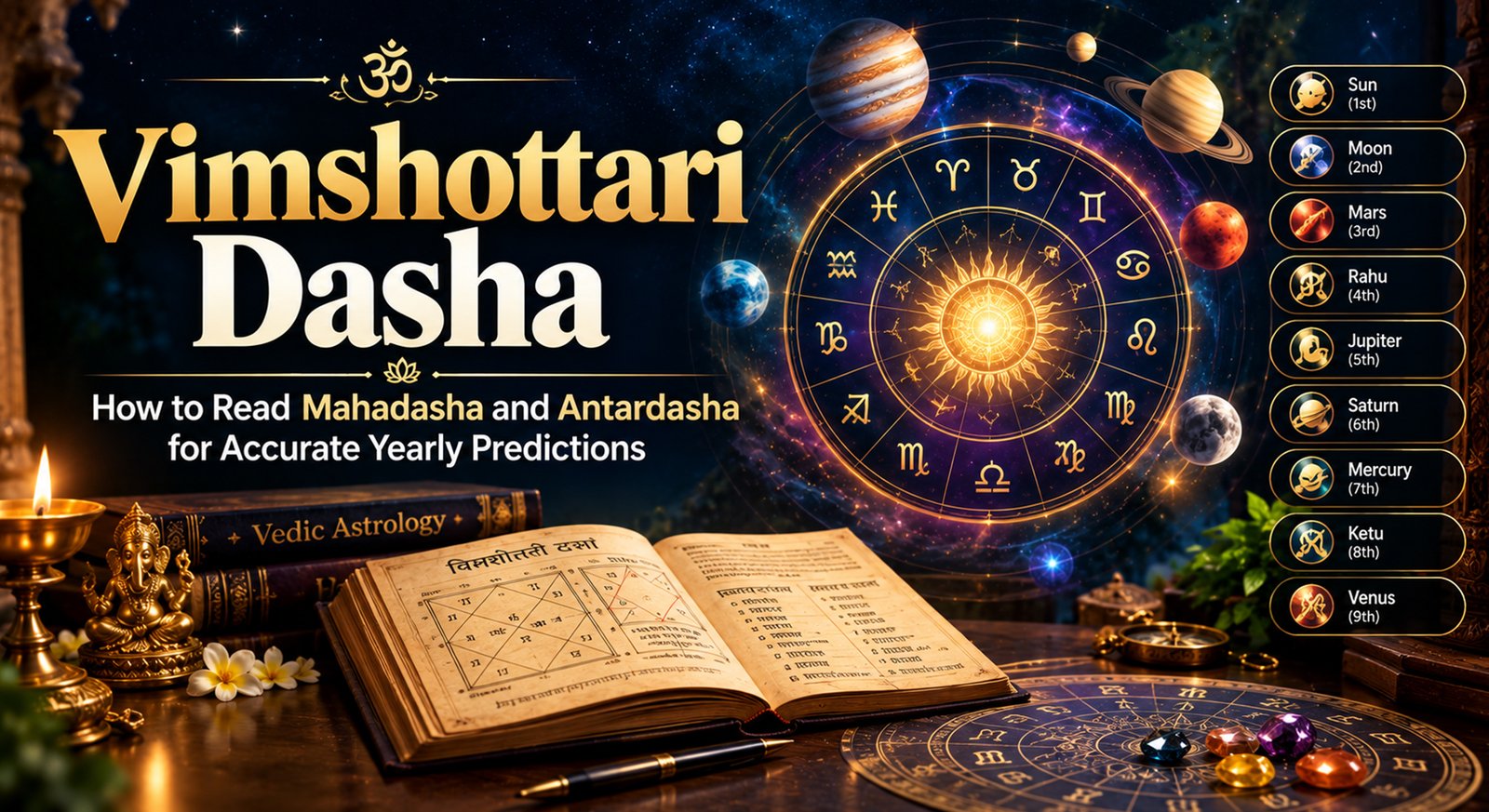
Vimshottari Dasha: How to Read Mahadasha and Antardasha for Accurate Yearly Predictions
If you have heard that vimshottari dasha is the key to timing events in Vedic astrology but still feel lost reading your own chart, you are not alone.
The problem is rarely the math. It is knowing what to focus on in Mahadasha and Antardasha for a specific year, and how to convert those Sanskrit-heavy rules into practical, yearly predictions.
What Vimshottari Dasha Really Tells You
At its core, this dasha system is a timetable of planetary periods showing which planet is “running” in your life at any moment.
That running planet colours the kind of events you attract, the people who show up, and the type of results you get from your efforts.
The big block of years is called Mahadasha, the sub-period inside it is Antardasha, and for yearly prediction you usually read both together, not in isolation.
Most students read the meanings of planets in a list and stop there. The real shift comes when you match that meaning with house ownership, house placement, strength, and current transit support.
How To Read Mahadasha Step By Step
Think of Mahadasha as the main theme of a long chapter of life. A Sun period, for instance, often pushes identity, status, father, and authority matters to the front.
To read your Mahadasha properly, follow a consistent checklist so you do not miss key factors.
Mahadasha Reading Checklist
- Check the planet’s house ownership in your birth chart (which houses it rules).
- See its sign, house, and conjunctions in the natal chart.
- Judge strength: dignity, combustion, retrogression, aspects received.
- Note its natural karakatwa (what it naturally signifies, like Venus for relationships and comforts).
- Connect this with past Mahadasha events in your life to see your personal pattern.
Mistake many people make: they judge Mahadasha only from the Moon sign and ignore the lagna chart. For accurate life themes, lagna-based reading is your base, then you can cross-check from Chandra lagna for mental experience.
How To Use Antardasha For Yearly Predictions
If Mahadasha is the chapter, Antardasha is the specific scene. A Mars sub-period inside Moon main period will show very differently compared to a Venus sub-period inside the same Moon main period.
For a single year forecast, the Antardasha and even Pratyantardasha (sub-sub period) are what fine-tune timing, but you start with the Mahadasha–Antardasha pair.
Reading Mahadasha–Antardasha Together
First, look at the natural relationship between the two planets. Friendly pairs tend to give smoother results, enemies create pressure, even with good placements.
Next, check how they are connected in your birth chart: signs, houses, mutual aspects, conjunctions, or exchange of signs. Every strong link makes that pair more eventful.
Then, narrow down the year in question and see which Antardasha actually covers that calendar year. That is the window you are reading in detail.
For example, if you are in Moon main period and Venus sub-period from August 2026 to December 2027, then your prediction for all of 2027 primarily comes from that pair.
Using A Vimshottari Dasha Calculator Without Getting Lost
Online tools such as a vimshottari dasha calculator or mobile astrology apps can quickly show the exact dates of all your periods.
The risk is people stare at the table, panic at a Saturn or Rahu period, and jump to conclusions without context.
Use a trusted vimshottari mahadasha calculator for timing, then always bring the results back to the birth chart for interpretation. The table is the clock; the chart is the story.
Many sites also provide a visual vimshottari dasha chart. That view makes it easier to see when big shifts in life themes happen, such as moving from a benefic to a malefic, or from a career-focused ruler to a relationship-focused one.
Planet-Wise Reading: Example Of Jupiter Period
A lot of students are confused when they enter jupiter vimshottari dasha, expecting instant luck or spiritual awakening.
In practice, Jupiter as Mahadasha ruler tends to expand whatever it touches. If it owns the 2nd and 5th houses in your chart, wealth, children, and education themes get highlighted, but only as per its strength.
Key Checks In Jupiter Mahadasha
- See in which house Jupiter sits and which houses it aspects.
- Judge whether it is benefic for your lagna or a functional malefic.
- Watch the Antardasha planet: Jupiter–Saturn will test discipline, Jupiter–Moon will tilt toward family and emotional security.
- Check current major transits of Jupiter and Saturn to see if they support or strain the dasha promises.
If your Jupiter is weak or heavily afflicted, the period can bring overconfidence, over-spending, or legal and moral troubles instead of growth. The planet fulfils its nature in your real chart, not in a textbook description.
From Meaning To Prediction: Turning Theory Into A Yearly Forecast
Reading yearly events from this system becomes easier when you follow a set structure every time.
Start by clarifying the life area you want to see for that year: career, marriage, education, or health. Vagueness is the enemy of useful prediction.
Step-By-Step Yearly Reading Flow
- Identify the running Mahadasha and Antardasha for the full year from a vimshottari dasha calculator free or software.
- Judge those two planets from lagna and Moon: ownership, placement, aspects.
- Focus on the relevant houses for the question, such as 10th for career or 7th for marriage.
- See transits of Saturn, Jupiter, and Rahu–Ketu over those houses and the Mahadasha lord.
- Break the year into quarters using Pratyantardasha if you need finer timing.
If you want to see trends for a specific upcoming year like mahadasha antardasha 2027, you simply extend the same method to the period covering that year, and then note the key milestones that cluster around planetary sign changes or Saturn and Jupiter station points.
One practical tip: write your forecast for the year in simple language, in a notebook or notes app, before you talk to anyone about it. That way, you judge the technique on its own, not mixed with other people’s worries or hopes.
Common Mistakes In Understanding Vimshottari Dasha Meaning
Many learners get stuck because they overcomplicate the rules or cling to fixed outcomes described in classic texts.
The basic vimshottari dasha meaning is simple: it is a timing system that activates the karmas of the ruling planet in a sequence.
Mistake one is reading the planet as uniformly good or bad, ignoring that the same Venus can signify a spouse for one lagna and losses for another, depending on which houses it rules.
Mistake two is predicting after one indicator. Dasha alone, without support from house strength and transit, rarely creates big events. The most reliable predictions come when at least two or three clear factors point to the same result.
The final mistake is fear. People see a so-called “difficult” period and expect only suffering. In reality, intense dashas often bring both challenge and meaningful achievement, especially when you consciously align your actions with that planet’s healthier expression.
Conclusion
Reading Mahadasha and Antardasha for accurate yearly predictions is less about memorising rules and more about applying a steady, stepwise method to your own chart using vimshottari dasha as the timing frame.
As you keep testing predictions against real events, your confidence grows and you know when to seek deeper guidance from an experienced astrologer or a service like Bhavishya Astro; start with one coming year, write your interpretation, and watch how life answers it.
Frequently Asked Questions
Q1. How do I find my current Mahadasha and Antardasha?
Ans. You can cast your birth chart using any reliable Vedic astrology software or website and then view the dasha table section. It will show the running Mahadasha and Antardasha along with start and end dates. Always confirm your birth time as accurately as possible before trusting the periods.
Q2. Which is more important for yearly prediction, Mahadasha or Antardasha?
Ans. Both matter, but for a single year the Antardasha usually shows more specific events while the Mahadasha provides the background theme. Think of the Mahadasha as the broader climate and the Antardasha as that year’s season. You will get the best results when you read them together with key transits.
Q3. Can a good planet give problems in its dasha?
Ans. Yes, even benefic planets can give stress if they rule challenging houses or are weak or afflicted in the chart. For example, Jupiter ruling the 6th or 8th can bring work pressure, debts, or health issues in its period. The actual result depends on the entire chart rather than the planet’s reputation alone.
Q4. How accurate are online vimshottari dasha calculators?
Ans. The calculations are generally fine as long as the software follows standard Vedic methods and you enter your birth data correctly. The real gap is in interpretation, because no calculator can fully judge house strength, yogas, and your life context. Use online tools for timing, not final predictions.
Q5. How often should I recheck my dasha for planning life decisions?
Ans. You do not need to look at it every week. For most people, reviewing the dasha pattern once or twice a year is enough, usually before major decisions around career moves, marriage, or relocation. Too-frequent checking can create anxiety and make it harder to act with clarity.
Q6. Can vimshottari dasha alone predict exact dates of events?
Ans. On its own, the system usually points to periods and windows rather than exact dates. Astrologers often combine it with transits, divisional charts, and sometimes other dasha systems to refine timing. Expect ranges of time where certain events are more likely instead of single guaranteed dates.