

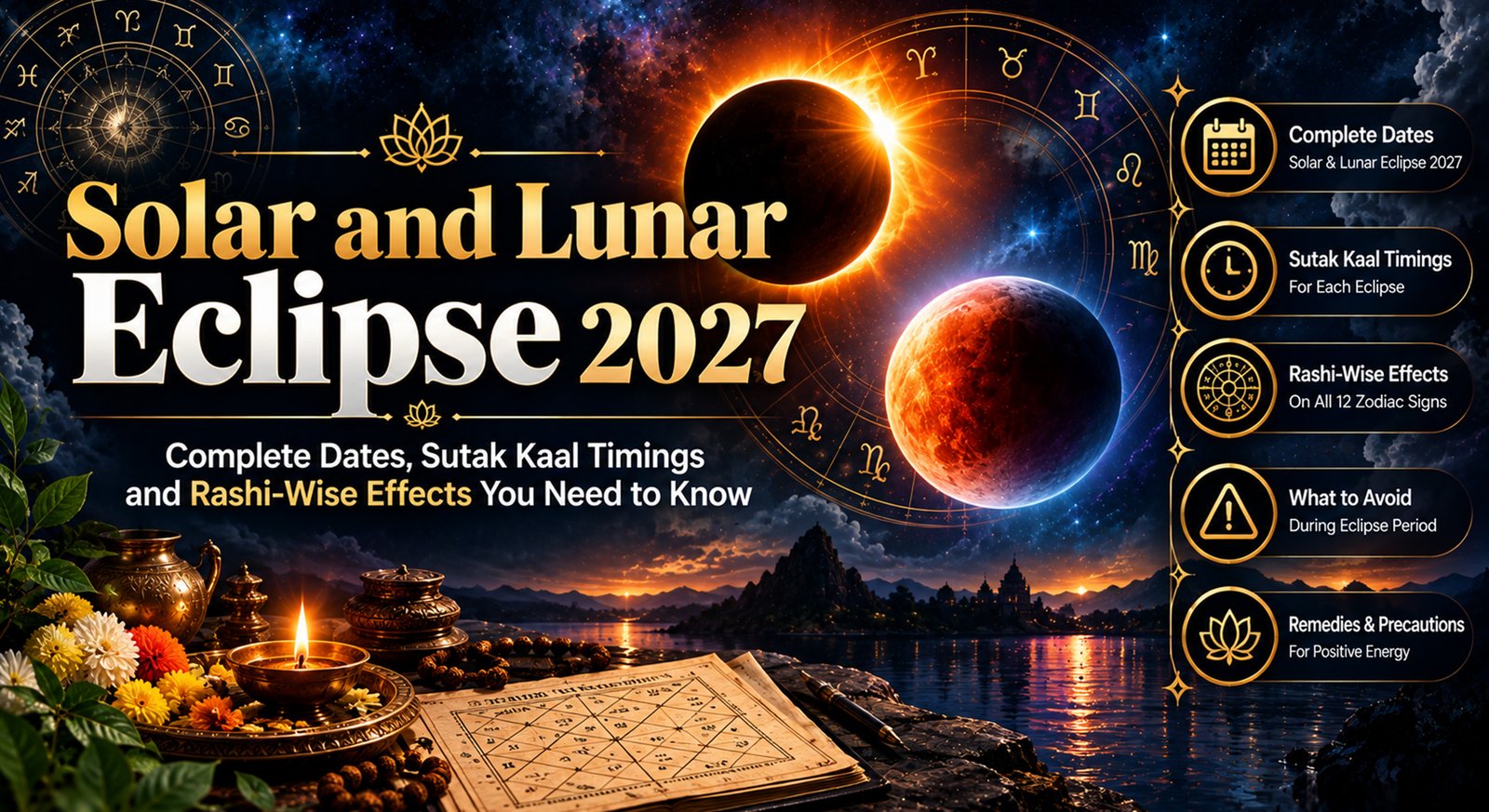
Solar and Lunar Eclipse 2027: Complete Dates, Sutak Kaal Timings and Rashi-Wise Effects You Need to Know
If you’re already hearing talk about eclipse 2027 in family WhatsApp groups, you’re not alone. Eclipses tend to bring a mix of excitement, fear and practical confusion about dates, Sutak rules and what it means for each rashi.
Here’s a clear, Panchang-based guide to the 2027 solar and lunar eclipses, especially for India and New Delhi, with exact timings, how Sutak works, and what these events may mean astrologically for each sign.
All Eclipse 2027 Dates And Sutak Kaal At A Glance
For 2027, there are five eclipse events globally. From an Indian perspective, the most spiritually sensitive one is the total solar eclipse 2027, seen as a partial eclipse in New Delhi on Monday, 2 August 2027, where Sutak does apply.
The other events are either not visible from Delhi, or are penumbral lunar eclipses which many traditional almanacs don’t count as full Grahan for rituals. Still, it helps to know the exact timings so you’re not relying on rumours.
Solar And Lunar Eclipse 2027 Date And Shubh Muhurat (New Delhi)
- Date: Saturday, 6 February 2027 – Annular Solar Eclipse (Surya Grahan) – Not Visible in New Delhi (No Sutak)
- Date: Sunday, 21 February 2027 – Penumbral Lunar Eclipse (Chandra Grahan) – 2:42 AM to 6:43 AM (IST) – Traditionally No Sutak
- Date: Sunday, 18 July 2027 – Penumbral Lunar Eclipse (Chandra Grahan) – 9:28 PM to 9:37 PM (IST) – Traditionally No Sutak
- Date: Monday, 2 August 2027 – Total Solar Eclipse (Surya Grahan) – Partial in New Delhi – Eclipse from 3:53 PM to 5:02 PM (IST), Maximum at 4:29 PM (IST)
- Sutak Kaal (New Delhi, 2 August 2027): 3:53 AM to 5:02 PM (IST)
- Date: Tuesday, 17 August 2027 – Penumbral Lunar Eclipse (Chandra Grahan) – Not Visible in New Delhi (No Sutak)
For Delhi, only the 2 August 2027 solar event carries a full Sutak period, starting 12 hours before the local beginning of the eclipse and ending when the partial phase ends. Other cities in India will have slightly different contact times, so check a local Panchang for your exact location.
In practice, this means most routine religious activities only need adjusting on 2 August 2027 during the stated window; for the penumbral lunar events, many households continue their usual routine.
How Sutak Kaal Works For Solar And Lunar Grahan
Sutak is the period of impurity observed before and during an eclipse, mainly affecting temple rituals, cooking fresh food, and activities like japa and puja at home.
For solar eclipses, classical texts work with a 12-hour Sutak before the first contact at that place. For lunar eclipses, the rule is 9 hours. But there are two key practical filters people often miss.
Visibility And Type Of Eclipse Matter
First, Sutak applies only where the eclipse is actually visible. So for the annular 2027 solar eclipse on 6 February that can’t be seen from New Delhi, there is no Sutak there according to standard Panchang listings.
Second, most traditional calendars don’t treat a purely penumbral lunar eclipse as full-fledged Grahan. That’s why on 21 February and 18 July 2027, they record the astronomical timings but leave Sutak blank for New Delhi.
What To Avoid And What To Prioritise
On 2 August, during Sutak and until the eclipse ends, many families in India avoid cooking, eating fresh food, and beginning new ventures, contracts or travel plans unless timing is unavoidable.
People often set aside this window for mantra japa, simple meditation or quiet reading of sacred texts. Pregnant women in particular may choose to stay indoors with curtains drawn during the active eclipse phase, as guided by doctors and family elders.
Surya Grahan 2027: Astronomical And Spiritual View
The highlight of 2027 solar eclipse events for India is the total solar eclipse of 2 August, visible as a partial eclipse in New Delhi from 3:53 PM to 5:02 PM with maximum coverage at 4:29 PM.
Astronomically, this is the Moon coming exactly between Earth and Sun, temporarily covering part of the solar disc for observers in India. Astrologically, it activates the sign and nakshatra where the Sun and Moon conjoin with the nodes.
Practical Tips For 2 August 2027
In most Indian homes, people either finish their main meals before Sutak begins at 3:53 AM, or wait to eat freshly cooked food until the eclipse ends at 5:02 PM, using stored or dry items in between if needed.
Many parents keep children indoors for the one-hour eclipse window, or if they do go out, they avoid looking at the Sun directly and don’t rely on improvised filters like sunglasses or old X-ray films.
Chandra Grahan 2027: What Penumbral Eclipses Signify
In 2027, lunar events visible from Delhi on 21 February and 18 July are penumbral eclipses. Here the Moon passes only through Earth’s outer shadow, so the dimming is very mild and often goes unnoticed to the casual eye.
Because of this, many Vedic practitioners consider these nights more like sensitive full moons rather than full Grahan, and treat them as days for inner work rather than fear or heavy ritual restrictions.
How To Observe These Lunar Nights
On these dates, those who follow a spiritual path may quietly increase mantra chanting, fasting according to their health, or simple moon meditation without changing their entire family’s routine.
If your mind tends to be restless around full moons, treat these nights as a signal to finish arguments early, avoid big emotional decisions, and sleep on any major choice until the next day.
Rashi-Wise Astrological Effects Of Eclipse 2027
Astrological impact depends on where the eclipse falls in your birth chart, not only your Moon sign. Still, rashi-wise guidance gives a broad sense of focus areas, especially around August 2027.
Take these as directions to be more conscious, not as reasons to panic. Eclipses tend to expose what is already weak or overdue for change.
General Themes For Each Rashi
Mesha (Aries): Work and daily routine may feel disrupted. Guard your temper with colleagues, and pace yourself on new projects around the eclipse period.
Vrishabha (Taurus): Focus falls on children, creative projects and speculative gains. Avoid gambling-style risks, and pay attention to how you handle promises in love.
Mithuna (Gemini): Home and family matters may demand attention. This is a good time to settle pending property discussions, but avoid signing in a hurry during the active eclipse hours.
Karka (Cancer): Communication, siblings and short journeys are highlighted. Double-check travel plans and think twice before sending emotional messages or making public statements.
Simha (Leo): Money, salary negotiations and self-worth issues may surface. Keep accounts neat and avoid impulsive purchases in the eclipse window.
Kanya (Virgo): Personal goals and health come into focus. Listen carefully to your body, adjust sleep timings, and don’t over-commit at work.
Tula (Libra): Hidden fears, old karma and subconscious patterns may become clearer. Gentle spiritual practice can help; avoid over-isolating yourself.
Vrischika (Scorpio): Friendships and social circles are activated. Notice who truly supports you and avoid power struggles in groups around this time.
Dhanu (Sagittarius): Career and public image stand highlighted. Maintain professionalism, avoid gossip and stay patient with organisational change.
Makara (Capricorn): Long-distance travel, higher studies and legal matters may shift. Keep paperwork clean and avoid last-minute bookings or filings near the eclipse hours.
Kumbha (Aquarius): Joint finances, loans and emotional intimacy need careful handling. Avoid fresh debt right in the eclipse period unless already committed.
Meena (Pisces): Partnerships of all kinds may go through renegotiation. Use this period to clarify expectations rather than to issue ultimatums.
Simple Remedies And Practical Do’s And Don’ts
For most people, handling eclipse energy is less about complex rituals and more about a few calm, consistent practices.
If your chart is sensitive to the eclipse axis, a competent astrologer may suggest personalised mantras or charity, but even simple actions can help you stay centred.
Traditional Practices Often Followed In India
Many families recite simple mantras during the active eclipse window, keep unnecessary screens and noise off, and sit together in one room quietly while the event is on.
People who follow strict rules avoid cutting hair or nails, sewing, or intense physical intimacy in this period, treating it like a short vrata focused on inner clarity.
After The Eclipse
Once the 2 August eclipse ends at 5:02 PM in New Delhi, people usually discard any Tulsi or Kusha leaves kept in food, bathe if health allows, and clean the puja space before lighting a fresh diya.
Families with small children or elders tend to be more flexible, adjusting rules to health needs rather than forcing strict fasting or long gaps between meals.
Conclusion
The 2027 eclipse cycle brings one major solar event for India on 2 August, with clear Sutak Kaal for New Delhi and more subtle lunar effects around the penumbral nights. Understanding these timings and likely rashi-wise themes lets you plan calmly instead of reacting to rumours about eclipse 2027.
If you feel your personal chart is strongly tied to these degrees, reach out to a trusted astrologer or a platform like Bhavishya Astro for deeper guidance, and treat each eclipse as a chance to reset your routine and intentions rather than something to fear.
Frequently Asked Questions
Q1. When is the main solar eclipse in 2027 for India?
Ans. The key solar event for India in 2027 falls on Monday, 2 August 2027, when a total solar eclipse globally appears as a partial eclipse in New Delhi from 3:53 PM to 5:02 PM IST, with maximum at 4:29 PM.
Q2. What are the Sutak Kaal timings for 2 August 2027 in New Delhi?
Ans. For New Delhi, Sutak for the 2 August 2027 solar eclipse starts 12 hours before first contact, at 3:53 AM, and ends when the eclipse ends at 5:02 PM IST. Many people adjust eating and religious activities within this window.
Q3. Is Sutak observed for the penumbral lunar eclipses in 2027?
Ans. Most traditional Panchangs do not observe Sutak for penumbral lunar eclipses, including those on 21 February and 18 July 2027 in New Delhi. They list the timings as astronomical events, but ritual restrictions are usually not applied.
Q4. Does the 6 February 2027 annular solar eclipse affect rituals in Delhi?
Ans. The 6 February 2027 annular solar eclipse is not visible from New Delhi according to current calculations, so standard almanacs say Sutak is not applicable there. Local rituals in Delhi generally continue without eclipse-related changes.
Q5. How can I see the 2027 solar eclipse safely from India?
Ans. If you choose to observe the 2 August 2027 eclipse, use certified eclipse-viewing glasses or indirect viewing methods and never look directly at the Sun with naked eyes, sunglasses or makeshift filters. Children should always be supervised closely.
Q6. Do eclipses always bring bad luck for a rashi?
Ans. Eclipses tend to highlight areas that need change or attention rather than automatically bringing misfortune. Their impact depends on your individual chart, so broad rashi-wise guidance is only a starting point, not a fixed prediction.